
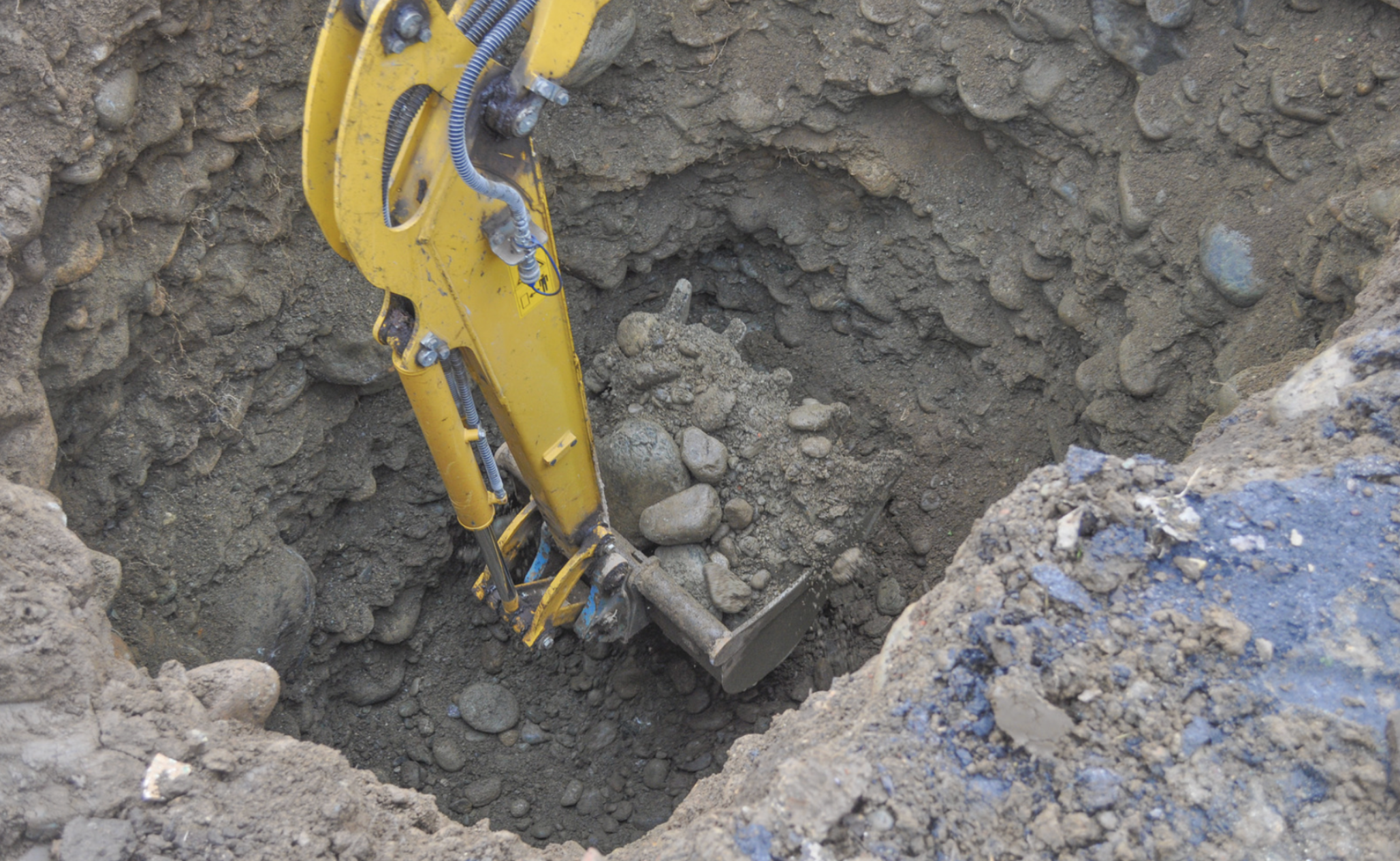
When faced with a failing pipeline, there are normally two options on the table: dig it up and replace it, or use a trenchless method to rehabilitate it in place.
On the surface, open-cut replacement feels like the reliable, proven choice. The pipe is new. The problem is solved. But the sticker price on an open-cut project can take a toll on the budget. When you account for everything a major excavation actually costs (pavement, traffic, utilities, time, and community disruption), the math shifts dramatically.
This is a straight comparison of what trenchless pipe repair costs versus open-cut pipeline repair in a municipal context, and why the decision is rarely as simple as comparing per-linear-foot contract prices.
The Problem with Comparing Line Items
Most public works departments evaluate pipeline repair proposals by looking at the contractor’s per-linear-foot cost. It’s a reasonable starting point. But it captures only a fraction of the true project cost.
Open-cut replacement generates a cascade of secondary costs that are real, significant, and often underestimated at the project planning stage. Trenchless rehabilitation, by contrast, concentrates the cost in the contractor line item while dramatically compressing or eliminating those secondary expenses.
To make a genuinely informed decision, total project cost (not just construction contract value) needs to be the basis for comparison.
The True Cost of Open-Cut Pipeline Replacement
Here’s what open-cut pipeline replacement actually costs a municipality, beyond the pipe and labor:
Pavement Removal and Restoration
This is frequently the single largest secondary cost in an urban open-cut project. Cutting, removing, backfilling, and fully restoring asphalt or concrete pavement can easily run $50–$150 per square foot depending on pavement thickness, material type, and local labor costs. A 1,000-foot pipeline replacement under a two-lane road with a 10-foot trench width generates 10,000 square feet of pavement restoration. At $80/SF, that’s $800,000 in pavement alone, before touching the pipe.
And that figure doesn’t account for the reality that pavement cuts never restore to original condition. Municipalities often face expedited pavement degradation along the repair corridor and return for additional surface work years ahead of schedule.
Traffic Control and Detour Costs
Sustained lane closures in urban environments require traffic control plans, signage, flagging crews, and sometimes law enforcement. For arterials and collectors, lane closures that extend over multiple weeks generate high ongoing costs. If a detour route is required, the traffic management costs and the downstream costs on businesses and emergency response routes compound further.
The Federal Highway Administration (FHWA) has documented that road user costs (delay, detour, fuel, vehicle wear) during construction can equal or exceed the construction contract value on busy urban corridors (FHWA, “Work Zone Road User Costs”).
Utility Conflicts and Relocations
Urban corridors are crowded underground. Open-cut trenching in a developed right-of-way routinely encounters gas lines, electrical conduits, telecommunications, water services, and storm drain laterals. Conflicts may require temporary relocations, protective measures, or work stoppages, all of which generate cost and schedule impact. Utility strikes during excavation carry safety liability on top of financial exposure.
Business and Community Disruption
For municipalities, the political and economic cost of prolonged construction disruption in a commercial corridor is real, even if it’s hard to put a precise number on. Lane closures that hamper access to businesses, noise and vibration complaints, dust and sediment issues, and construction aesthetics that persist for weeks all carry cost in the form of community relations management, elected official attention, and potential economic impact claims from affected businesses.
Environmental Permitting and Mitigation
Projects in environmentally constrained areas (near wetlands, riparian zones, coastal areas, or within habitat corridors) may require environmental review, mitigation measures, or agency coordination that can add months to a project timeline and high cost to the budget.
Schedule Risk
Open-cut projects carry inherent schedule risk from subsurface unknowns. Unexpected groundwater, unsuitable native soils requiring over-excavation and import fill, buried obstructions, and utility conflicts can all extend project duration and inflate cost. These risks are transferred to the owner in many contract structures, meaning change orders flow back to the agency.
The True Cost of Trenchless Pipe Rehabilitation
Trenchless rehabilitation concentrates cost differently. The contractor price is typically higher per linear foot than a straight pipe-in-trench bid, but the secondary cost picture looks fundamentally different.
Minimal Excavation
Most trenchless methods require only small access pits at each end of a rehabilitation section. For a system like Primus Line®, two access pits per section are standard: typically 4×6 feet, depending on pipe depth. For CIPP, access is similar. Compare that to a continuous 1,000-foot open trench, and the pavement restoration calculation shrinks from tens of thousands of square feet to a few hundred.
Compressed Construction Duration
Trenchless installations move quickly. A Primus Line® installation can rehabilitate thousands of feet of pipe in days, not weeks. CIPP and SIPP projects similarly compress field time compared to open-cut timelines. Shorter projects mean reduced traffic control costs, reduced mobilization overhead, and faster return to normal operations.
Preserved Surface Infrastructure
Roads, landscaping, hardscape, mature trees, and surface improvements remain intact. This is especially significant in established residential neighborhoods where community expectation of surface preservation is high, or in locations where pavement restoration costs alone would tip the financial comparison.
Reduced Utility Conflict Exposure
By working through the existing pipe envelope, trenchless methods dramatically reduce the chance of striking or disturbing adjacent utilities. The trench that exposes utility conflicts doesn’t exist.
Environmental Compatibility
Trenchless rehabilitation is often the only viable option in environmentally sensitive locations. The Half Moon Bay project completed by Advantage Reline is a direct example: the client chose Primus Line® specifically because the pipeline ran adjacent to Highway 1 and a coastal wetland where excavation was not a permittable option. Avoiding environmental permitting and mitigation translated to real cost and schedule savings.
A Side-by-Side Cost Framework
The following framework helps public works directors structure a genuine total cost comparison:
| Cost Category | Open-Cut Replacement | Trenchless Rehabilitation |
| Construction contract (pipe + labor) | Typically lower per LF | Typically higher per LF |
| Pavement removal and restoration | High (full trench length) | Minimal (access pits only) |
| Traffic control | High (weeks of lane closure) | Low (short duration) |
| Utility conflict management | High exposure | Low exposure |
| Environmental permitting | Variable to high | Typically minimal |
| Business disruption management | High in commercial areas | Low |
| Schedule risk/contingency | High | Low |
| Total project cost | Often 1.5–3x construction contract | Closer to construction contract |
The American Water Works Association’s research (AWWA, “Buried No Longer”) consistently shows that total project costs for trenchless water main rehabilitation run 30–50% below open-cut replacement — and that gap widens in urban and environmentally constrained environments.
When Open-Cut Is the Right Answer
Trenchless methods are not universally applicable. There are conditions where open-cut replacement is genuinely the better or only option:
Severe Structural Failure.
A pipe that has collapsed, buckled, or been crushed beyond the ability to pass inspection tooling or liner systems requires excavation. Trenchless rehabilitation requires a host pipe that can still physically accept the liner.
Capacity Upgrades.
If the rehabilitation goal includes upsizing pipe diameter to meet increased demand, trenchless methods that work within the existing pipe envelope cannot achieve that objective. New, larger pipe requires a new trench.
Extremely Short Sections.
For very short repairs where the access pit cost dominates the trenchless equation, open-cut may be more economical.
Inaccessible or Unusable Host Pipe.
If the existing pipe material is incompatible with available liner systems, or if the pipe geometry prevents liner insertion, trenchless options may be limited.
A thorough pipe assessment is the right way to determine which conditions apply on any given project before committing to a method.
Making the Case Internally
Public works directors sometimes face internal pressure to choose open-cut because it’s familiar, because it replaces the pipe entirely, or because it’s easier to explain to elected officials. Here’s how to frame the trenchless case effectively:
Present total project cost, not just the construction contract bid. Line up the secondary costs explicitly so the comparison is apples to apples.
Use local reference projects. Nothing is more persuasive than a similar agency nearby that achieved strong results with trenchless rehabilitation. Ask your contractor for references from comparable municipalities.
Document the disruption avoided. Quantifying lane-closure days, pavement restoration square footage, and utility conflict exposure gives the comparison tangibility beyond per-foot pricing.
Cite the manufacturer warranty. Trenchless liner systems from reputable manufacturers like Primus Line® carry long-term warranties and documented service life of 50+ years. That’s a capital investment with a known horizon, not a repair that buys a few more years.
Calculate the True Cost Before You Dig
The total cost of pipeline repair in a municipal context is never just the contractor’s bid price. Pavement, traffic, utilities, schedule risk, and community impact are all real costs that belong in the comparison — and they consistently favor trenchless rehabilitation in the urban environments where most municipal pipeline infrastructure is buried.
If your agency is evaluating a pipeline repair project and hasn’t run the full cost comparison, that analysis is worth doing before you issue the bid documents.
Request a bid from Advantage Reline and let our team help you build the full picture — including a trenchless scope, timeline, and total cost estimate that makes the case clearly.